Intro

All content of this blog is my own opinion only. It does not represent the views of any organisation or association I may work for, or be associated with. Nothing within this blog should be considered as medical advice and you should always consult your Doctor.
Showing posts with label Tizzie Hall. Show all posts

Can Bad Parenting Advice Result in Death?

The baby industry isn't really regulated, meaning pretty much anyone can set themselves up as an expert; without a single qualification, advice can be served to the masses via all forms of media.  This is most profitable when the advice is "parent pleasing" - i.e. typically promising abnormally long sleep spells, unnaturally structured feeding patterns and so on.  Parents can regain the order of their "pre-baby lives", just by following their simple rules (although they don't like the word rule, they prefer terms like "technique").  Any potential risk to baby is quietly swept under the carpet in favour of parental benefits.

Some of these "techniques" are considered harmful, whilst others feel it just comes down to choice and difference of opinion.

But what about when parenting advice goes beyond this.  What about when it's something that could pose a significant risk to life?

A prime example of this is swaddling advice from self proclaimed "International baby whisperer", Tizzie Hall.

You may recall I have taken issue with her advice before here and here. Despite a detailed and clear response from FSID, Tizzie was not prepared to re-consider her position.  Questions and comments from concerned parents on her Facebook page were heavily moderated, and numerous people complained of being banned..

Below is from her website:

What Tizzie fails to mention is that chest clips aren't standard in "some countries", e.g. the whole of Europe, because the USA chest strap is very controversial in terms of safety.  This website explains in detail why a chest strap shouldn't be used with a 5 point harness.

It's for these reasons the Houdini strap (shown in the above picture), an item intended to prevent toddlers taking their arms out - is designed to snap when significant forces are applied.  For a baby swaddled as above, should the chest strap break, is there the potential for baby to be propelled from the seat?

Kidsafe Queensland, a not-for-profit organisation dedicated to preventing unintentional childhood injuries believes so:
"DO NOT UNDER ANY CIRCUMSTANCES wrap your baby like this in a swaddle or blanket and place in a child car seat or a pram/stroller. Arms and legs MUST be sticking out of the harness straps. The Houdini strap is not recommended and is designed to break apart in a crash therefore your baby could be ejected from the child car restraint or could jack knife out. See the case of Qld baby Isobella who was ejected right out of the car because she was swaddled then placed in her baby safety capsule. She died at just 4 months of age. The parents simply did not know of the danger they were placing her in.”
Car Seats for the Littles Inc, an organisation staffed by Child Passenger Safety Technicians to sharing injury-prevention information say:
"As a general rule, products sold separately from your child restraint should not be used, due to the fact that these products may affect the safety of your restraint in a crash. Even a seemingly minor change to your restraint could alter the way is designed and tested to perform in a crash, resulting in serious injury or death."
Even the manufacturer's instructions warn parents that third party "add on" products may be unsafe, plus they may invalidate the warranty.  Britax for example state:
"The use of non-Britax Child Safety, Inc covers, inserts, toys, accessories, or tightening devices is not approved by Britax. Their use could cause this restraint to fail Federal Safety Standards or perform worse in a crash. Their use automatically voids the Britax warranty." see more here.
But let's be realistic, who cares about a warranty if their baby has life changing injuries or worse?

The press have at least picked up on the image both in the UK and Internationally.  The Daily Mail featured this story: http://www.donotlink.com/fufe concluding:
"Ms Hall has declined to comment when contacted by Daily Mail Australia".
With a heavily censored social media presence, and followers trotting out statements like:
"And here we go again! Leave the women alone. If you don't agree with her advice, stop following her page for god sakes. So over 'hero' parents attacking Tizzie. Just cause you think YOUR right, doesn't mean you are." [sic]
and
"Use her advice or don't. Ah the keyboard warriors attack Tizzie. Well done, hope you feel better for getting that off your chest...now do us all a favour, unlike the page and move along."
I have to wonder, where do things go from here?

Apparently Tizzie intends to defend her practice with claims that carseats are safe for amputees after all, and that in the case above of the little Isobella, the driver were speeding anyway. I kinda thought that was the point of crash tests, that it was a worst case high impact collision - after all the baby can't tell the driver to slow down.

 But she's even more cryptic on her fanpage. In response to a mum posting:
"this article makes it clear that it goes against the Australian standards and guidelines and its not good practise to recommend against those standards" [sic]
Tizzie replies:
"It is a hard one Anne-Marie, I would love to come out with more information as to why I say to swaddle a baby but it would scare too many parents. Maybe you could call your car seat company and ask them what weight and what age baby can go in a baby capsual and see what they say ask them what age and weight they are tested for. Soon this debate will be over because they are starting to bring in safer car seats for prem babies and newborns with the correct testing done on the new ones. Tizzie" [sic]
Parents can't handle it?

I'm not sure why some random person feels they are in a position to contradict world safety experts, and give conflicting advice without even warning parents it's controversial.  If you're so certain, surely the answer is to take your research and test results to leading safety consultants, and engage appropriately so people take you seriously? That way your message could reach millions rather than a few thousand.

I've never seen insurance for "baby experts", but I imagine if it exists Tizzie's underwriters are squirming right about now. In Australia, standards are enforced by the Australian Competition and Consumer Commission, who have previously engaged with Tizzie on the issue. Perhaps they could shed more light on how safe they feel this practice to be?  
"The ACCC got in touch with me years ago and asked me to remove the advice from my website but, after I sent them the information I gathered, they instead asked me to change the wording,” she said.
“I had to make it clear that I recommended wrapping with a light cotton wrap only, not with a blanket.
They made it clear they still weren’t happy with my advice but I didn’t have to take it down." here
What are your thoughts?

Why I'm concerned about Tizzie Hall's Breastfeeding Advice - PART TWO


Continued from PART 1

What we also need to throw into the mix of Tizzie's breastfeeding advice is that she also recommends limiting the duration of feeds too:
Before milk comes in:
"Day 1: Feed every three hours from both breasts - 6 minutes per breast
Day 2: Feed every three hours from both breasts - 9 minutes per breast
Day 3: Feed every three hours from both breasts (if milk not in) 12 minutes per breast
Day 4: Feed every three hours from both breasts (if milk not in) 16 minutes per breast"

We know how important colostrum is for babies, it's often called "liquid gold".  Why would anyone want to limit the amount of this their baby receives?  Containing more white blood cells (antibodies) than blood, examine its properties further and you soon realise if it was bottled and sold we would be advised to encourage baby to consume as much as possible!

Once milk is in the routine is first breast 25 minutes, then second 15 minutes every 3 hours (alternating which you start with) then a shorter gap of 2 hours between 4-6pm followed by a 3 1/2 hr gap to 9.30pm.  By six weeks there is a 4 hour gap between the first and next feed and this extends until the gap is 4 hours throughout the day by 10 weeks (with 3.45 mins before the last feed) although it does switch to 25 minutes each breast at 6-8 weeks and then the timings just vanish from the routine (I'm assuming you can go wild and feed as long as you want at this point!)

Tizzie feels feeds need time limits so nipples can "toughen up" and "helps avoid cracked, sore or bleeding nipples, which can be horribly painful".
"Other babies are very sucky and if given the chance will stay sucking on the breast all day and night.  The mother could end up very sore and even cracked and bleeding nipples, especially if she is too exhausted to correctly latch her baby onto the breast."
To a new mum this may seem to make sense - but I feel it's based on myth as this blog post explores.  

Furthermore, science has examined this theory:
"To investigate the effects of the frequency and duration of breastfeedings on nipple soreness we studied two groups of mother-infant pairs during the first 10 postpartum days. Mothers in the control group fed on a 3- to 4-hour schedule and those in the experimental group were encouraged to breastfeed as frequently as the infants desired. All mothers recorded the time and duration of each breastfeeding for the first 10 days after delivery and gave their own daily assessments of nipple discomfort. Although mothers in the experimental group nursed significantly more frequently (10 vs. 7.4 feedings/24 hours, p >.0001), they did not experience more nipple soreness. There was no significant correlation between the frequency or duration of feedings and the degree of nipple soreness."
Does the Duration and Frequency of Early Breastfeeding Affect Nipple Pain?
Manoel de Carvalho M.D. Steven Robertson Ph.D. Marshall H. Klaus M.D.

Setting these sort of limitations on a newborn is quite mind boggling - but it doesn't seem to give any consideration to a baby not feeding well.  This is the group I'm passionate about as these tend to be the people I see/hear from day in and out.

If a baby is not for whatever reason transferring milk well - it's rather like you or I drinking from a squished straw.  Sure you get some liquid, but it makes your face ache and you stop long before you would if you had a normal straw.

These babies may fall asleep quickly at the breast - yet aren't really asleep and wake showing hunger cues as soon as they've moved.  They can spend an age at the breast and suck and suck, whilst consuming very little - a lot alternating between sucking, crying and cat napping..

In this situation the mum can develop sore/cracked nipples - but not from the constant feeding,  but from constant incorrect feeding.  If something is preventing the baby from performing the correct action, they can compensate with suction!  Some have a crushing very strong suck (as shown on ultrasound) which will absolutely crack and damage nipples.

Some feed very quickly but are hungry again half an hour to an hour later, or even sooner with feeds rolling from one into the next and the baby unable to settle.  I meet parents who say, I don't know what's wrong, it can't be hunger because he's been feeding for two hours!  Yet the baby would need to be attached 24/7 to take enough milk with how inefficiently they're feeding.  If you feel your baby never appears full or settled - seek help from someone appropriately qualified such as a breastfeeding counsellor or lactation consultant (I.B.C.L.C.).  This is not typical, but does not mean the only option is a strict routine.

I found Tizzie's book confusing in how one should deal with this though.

Firstly the baby falling asleep quickly:
Q.  My baby keeps falling asleep during a feed - what should I do?
A.  This is what I call a sleepy feeder.  If she dozes off before taking enough milk to get her to the next feed, you will start to have problems if trying to follow a routine.  Try changing her nappy or taking some clothes off as the cool air might rouse her.  You could also try putting her down somewhere safe to rest for ten minutes and then try the feed again.
Ok so what next?  If baby is not transferring milk well they WILL keep falling asleep - even after a 10 minute rest.  Then what happens if it gets near sleep time?

In one section of the book entitled "settling your new baby to sleep", it discusses a newborn not settling doing the "emotional cry" (ie the one Tizzie feels indicates a need).
"This cry I would never ignore.  Get the baby up and look for a problem, and if there's no visible problem I would offer some more milk".
I was quite heartened to read this although I did wonder which breast and how many minutes.

However still under "feeding in the first two weeks" it says:
"If you believe he is hungry between feeds and you have no expressed milk, just offer an extra feed for a few days no closer than two and a half hours after the last one."
Which suggests expressed milk is preferable if possible, but also seems to contradict the statement before?

The trouble with tiny babies is when they take insufficient calories the first thing they do is signal to feed; if this is ignored or their intake has dropped for another reason, they do one thing - sleep.  The more calories drop, the harder it is to rouse them to feed - especially at night. They stop spontaneously waking, and a mum has to start setting the alarm to "remind" her infant to feed.  It's also easy for a mum to think she has a "good" or "content" baby (because how long they will sleep now seems to define that in our society) who can't be hungry otherwise he would wake.  When she tries to wake him he struggles to rouse, compounding her belief he simply doesn't need to feed.

Whilst on Tizzie's Facebook group, I've read parents of young infants 7/8/9 weeks announce hurrah, their infant is sleeping 12 hours!  The response is often "great parenting", yet Dr Sears suggests otherwise:
"One thing we have learned during our years in pediatrics is that babies do what they do because they're designed that way. In the case of infant sleep, research suggests that active sleep protects babiesSuppose your baby sleeps like an adult, meaning predominantly deep sleep. Sounds wonderful! For you, perhaps, but not for baby. Suppose baby had a need for warmth, food, or even unobstructed air, but because he was sleeping so deeply he couldn't arouse to recognize and act on these needs. Baby's well being could be threatened. It appears that babies come wired with sleep patterns that enable them to awaken in response to circumstances that threaten their well being. We believe, and research supports, that frequent stages of active (REM) sleep serve the best physiologic interest of babies during the early months, when their well being is most threatened."
Dr Sears, 8 Infant Sleep Facts Every Parent Should Know

As clearly the above would for many ring alarm bells about supply, Tizzie recommends expressing alongside for the first 8 weeks.

In addition for the first two weeks until baby has regained their birthweight, mum has to set an alarm at night allowing a sleep of no longer than 5 hours.  After this mum can stop waking baby, but until 4 weeks she has to express after 6 hours if baby hasn't woken for a feed - but only needs to remove an oz (I'm not sure what this figure is based on)
"I strongly believe expressing in the early days is a key factor to having a good milk supply while following a routine."
and
"I encourage all my clients to express first thing in the morning and at other times in the day.  This is for two reasons.  One, this milk can be given in the bottle later in the day and some of it an be frozen and stored for when your baby has a growth spurt"
and
"After a few days your breasts will start to regulate and produce only the amount he is taking.  This is fine initially, but when your baby goes through a growth spurt in the early weeks you may not have enough milk to satisfy his needs.  This would result in you having to feed him more often and will get your routine off track.  It may also result in you feeding your baby too close to sleep time resulting in him using the feed as a going-to-sleep-aid."
Tell me, if it's so normal for a baby to follow the routine, why does one need to express to maintain a good milk supply?  Isn't expressing a lot more time consuming than just feeding more frequently when baby wants to up supply - the way he's supposed to?  Really is the world going to end if the routine goes out of the window for a few days?

The other issue I notice when young babies feed from very full breasts (which may happen following a 3-4 hour gap) is wind.  It seems Tizzie has noticed this too as she suggests mums should wind their baby every three minutes during a breastfeed.  By my calculations if a feed is as Tizzie advises 25 mins one breast and 15 the other - that's 13/14 windings per session!

My OH asked an interesting question after reading this entry, he said if you have to feed for 40 mins as per the routine, and you have to wind 13 times, if each winding is only 2 minutes - this is 26 minutes of winding.  Is this on top of the 40 mins feeding making each feed 1hr and 6 minutes or is it included?  ie 14 minutes actually feeding?

Looking at the routine

But none of it considers how unique each breastfeeding dyad is; that we know some mums have a larger initial store than others (although most can make roughly the same over 24 hours), that babies feed with different levels of effectiveness and that some mums have a bullet proof supply whilst others don't.

The last reason Tizzie gives for suggesting scheduled feeds is quality of milk - we are compared to cows in a dairy and our milk is claimed to be "similar to that of a cow" - which is eyebrow raising on so many levels.  Tizzie proposes that dairy farmers say the quality and quantity of milk increases if they stick to two set expressing times per day -" is it such a leap to assume that's so for babies?"

Tizzie that's not a leap, it's a freaking pole vault, of Olympic standard.

A dairy is not the normal environment for a cow you know?  When they have calves the farmer doesn't stand in the field with a stop watch, signalling when to start a feed and when to swap udders!

According to a dairy farmer, modern equipment allows the cows to choose their own milking times - and stated the times were set previously because of how long it takes to put a full herd through the milking process.  Hand reared calves are fed two - three times per day, and then also are offered hay and grains within a few weeks!  Bovine milk is designed to develop bulk not brains, because they're cows not humans.  In contrast, gorillas feed on demand as frequently as the guidelines suggest humans do.

Humans don't drink cow's milk because it's vaguely comparable (don't know about you, but I have just the one stomach!)  The protein size is cow sized not human, in fact sheep and goat's milk would be more comparable in some ways to human (although still not close)  Humans drink cow's milk because cows can produce vast amounts of milk whilst being cost effective to keep and docile enough to allow it.  Cow's milk has to be massively modified so a human infant can tolerate it and along with wheat is listed amongst the most common allergens.  Each mammals milk is species specific, the antibodies, hormones and everything else is only of use to the same species.  This is why there is a movement of mothers sharing human milk.

I appreciate Tizzie's book is opinion not a "science journal", but when your opinion is influencing how people raise babies isn't there some sort of ethical or moral obligation to at least consider how this sits with  the evidence?   I can understand areas where there is mixed evidence that it can come down to opinion, but some throw away comments are I think misleading:


When talking about prems:
"Often these babies are fed by tube or parents are advised to give their feeds from a bottle until the babies are strong enough to suck from the breast".
In an effort to refute the widely held assumption bottles are easier than the breast, one study sequenced babies to alternative between feedings at the breast and by bottle.  During bottle feeding infants showed:
  • Poorer coordination of sucking, swallowing and breathing
  • A greater number of oxygen desaturations
  • A significant fall in skin temperature
  • Shorter duration of feeding.
Meier P, Bottle and breastfeeding: effects on transcutaneous oxygen pressure and temperature in preterm infants.

Another study found bottle feeding increased the incidence of desaturation episodes compared to cup feeding (1) whilst another found a 10 fold increase in desaturation episodes to <90%, compared to "no change" whilst cup feeding (2)

When talking about multiples:
"Most mothers are capable of producing enough milk for more than one baby.  But it's also important to look at both your individual situation and your family's needs.  There is no point trying to breastfeed if you are finding yourself too tired to enjoy your babies, or you spend all your time worrying about whether they are getting enough food.  If you are concerned about this, talk to your health professional about their weight gain.  If they are all gaining enough weight, settling and sleeping well, then you know you are producing enough milk,  And remember, some breastmilk is better than none.  With this in mind, a lot of my clients have decided to give a mixture of breastmilk and formula."
Hang on, I thought the whole point of the routine was supposedly to "stop mothers feeling too tired to enjoy their babies?"  But to suggest there is "no point" if tired or concerned about weight seems really quite bizarre to me.  Mums don't need to stress about whether their infants are "getting enough" if they are peeing, pooping and gaining as expected, just like with a singleton; why does "sleep and settling" come into play?

To Tizzie's credit she does suggest mums struggling can contact the breastfeeding organisations, and gives further details of who they are - my only concern is that if mums contact them, they may end up extremely confused as the first thing they will say is "have you considered feeding your baby by cue, not a routine?"  The training to man these helplines includes looking at all the reasons a routine isn't the ideal for a breastfed baby.

Lastly here are the recommendations from the World's main sources of health care advice:

UNICEF's Baby Friendly Approach clearly states
"There should be no restrictions on the frequency or length of breastfeeds."
The NHS breastfeeding website reads:

"Feed your baby as often as they want. This is called baby-led feeding (it's also known as 'on-demand'). Let your baby decide when they’ve had enough. It's not necessary to time the feeds. In the beginning, it can seem that you're doing nothing but feeding, but gradually, you and your baby will get into a pattern of feeding, and the amount of milk you produce will settle.

It's important to breastfeed at night because this is when you produce more hormones (prolactin) to build up your milk supply. At night, your baby will be safest sleeping in a cot in the same room as you."

The Department of Health lists good practice as:
"Encourage breastfeeding on demand."
The American Academy of Paediatrics' breastfeeding policy states:
"To nurse whenever the newborn shows early signs of hunger, such as increased alertness, physical activity, mouthing, or rooting. Crying is a late sign of hunger. Nondemanding babies should be aroused to feed if 4 hours have elapsed since the beginning of the last nursing. Time limits for breastfeeding will be avoided"
The World Health Organisation recommends:
"Breastfeeding on demand – that is as often as the child wants, day and night."


1.  Rocha NM et al.  Cup or bottle for preterm infants: effects on oxygen saturation, weight gain, and breastfeeding.
2.  Marinelli KA et al.  A comparison of the safety of cupfeedings and bottlefeedings in premature infants whose mothers intend to breastfeed,

Why I'm concerned about Tizzie Hall's Breastfeeding Advice - PART 1

I'm going to make this two part entry my last for a while on the subject of Tizzie Hall. I mentioned in my last blog post that I wanted to cover one particular section of her breastfeeding advice - an area which concerned me. However this post ended up so long I have split it in half so you can stand a chance of getting to the end ;)

Part 1 which is below, explores restricting breastfeeding frequency, some of Tizzie's ideas and why I think mums planning on following Tizzie's advice should be cautious...

In her book "Save Our Sleep", Tizzie firstly suggests that feeding "on demand" may be linked to obesity in later life.
"If your baby knows you will keep offering him a snack every couple of hours, he will never feel the need to have a full feed.  Putting your baby on a routine gets him into the habit of filling right up when you offer the breast or bottle, because he soon learns it will be quite some time before you make the offer again."
and
"Teaching bad habits:
If you feed your baby every time he cries, you run the risk of teaching him that the answer to all his emotional ups and downs is to eat, irrespective of whether he is actually hungry.  For example, if a baby is tired and crying because he doesn't know how to put himself to sleep, feeding teaches that he needs to eat in order to fall asleep.  If a bored and crying baby is picked up and fed he starts to understand that if he is bored then eating will help.
My problem with this is that as your baby turns into a toddler, his whingeing will see you starting to replace bottles or breastfeeds with a piece of fruit or a biscuit which reinforces the regime of feeding him when he cries.  Perhaps that is one of the reasons why we now see a lot of obesity in children and teenagers, and why others eat to solve emotional imbalance."
What doesn't get a mention in the "obesity ponderings" is that not breastfeeding has long been linked with increased risk.  But that aside really just how healthy is "filling right up"?  Don't recommendations now support responsive feeding regardless of how an infant is fed?

Breastmilk is digested within a couple of hours, so a baby eating every couple of hours isn't "snacking" -  but eating normally.  Little and often is actually exactly how humans are supposed to eat, it keeps blood sugars stable and promotes normal metabolism.  Paul Mckenna's whole diet theory is based on adults learning to re-recognise when they are full, but at what point did they forget?  Milk is all an infant gets, their tummies are much smaller than ours - yet I wonder how many people reading ensure no food or drink passes their lips unless three hours has passed?

Lynne Daniels, a professor of nutrition at Queensland University of Technology, Australia, and researcher with the Early Prevention of Obesity in CHildren (EPOCH) collaboration, has demonstrated routine fed infants were heavier at 14 months than those fed responsively.

The professor said: 
"If the mother is responsive, she is responding to the child’s cues of hunger and not over-riding them.  Whereas, if a mother feeds in schedule, she decides whether or not he is hungry."
Quite.

Tizzie goes on to say:
"I don't want to infer that demand  feeding won't work for everyone.  In the end, all parents have to do what it best for them and if you are one of the lucky ones that can interpret your baby's cries, that's great."
It's fascinating that someone calling themselves a "Babywhisperer" thinks babies need to cry to tell you they're hungry.  Crying is the last cue of hunger - one that only comes out to play if all his earlier signs are ignored..

Secondly - Tizzie expects mothers to tell the difference between a "protest" (which she defines as the equivalent of a temper tantrum) and an "emotional" (has a need) cry, based on a description in her book - but then states mothers who can interpret cries are the lucky ones.  Confused yet?

Thirdly it assumes breastfeeding is all about calories.  It's not.

Truth is that the breast meets every need a newborn has except a dirty nappy - the skin to skin regulates their temperature and other vital stats, so baby doesn't need to expend energy doing so.  Milk is a live substance and at night contains properties that induce sleep, whilst the act of feeding releases hormones to relax both mum and baby (strange if we aren't meant to feed our infants to sleep or during the night!).  If baby is hungry or thirsty it nourishes, and it provides the ultimate security for a newborn who only has 25% of his brain fully developed at birth and who is working at a very primal level.

Furthermore breastfeeding is recognised as pain relieving, and in the early days has more antibodies than blood.  If baby is feeling under the weather he often turns to the breast, and with good reason.  The germ is passed to mum, she makes relevant antibodies and then passes them back to baby at subsequent feeds.

It is a baby's first "vaccination" and the most nutritionally complete food they will ever consume.

Let's look at Tizzie's list as to what she states prompts an "emotional cry" in her TV appearance with Kerry Ann::
  • Discomfort 
  • Hunger
  • Tiredness
  • Wind
  • Thirsty
  • Hot or Cold
Yep - breast takes care of those.  And want to know what else?
"It is now known that high levels of melatonin in breast-milk appear during the night and low levels during the day. Since melatonin is the hormone that regulates the sleep/wake cycle, these changes in breast-milk will doubtless be the signal to help the baby adapt as quickly as possible to the day/night versus sleep/wakefulness environment. (1-4)"
Yaha - so the breast even helps them start to regulate sleep cycles.  Top that Tizzie ;-)

What did bemuse me a little is how simplistic Tizzie's list of needs that can cause an emotional cry is - what about scared, lonely, needing a cuddle?   Tizzie claims in one of her TV interviews that she doesn't support "controlled crying" - the act of leaving a baby to cry but checking in with them every so many minutes. She states that if you return to an infant when they're "protesting", they will then start an "emotional cry", feeling rejected they've been left.

Yet walking in and out wouldn't cause any of the list above, which would seem to prove that babies cry an "emotional cry" for not only the six tangible reasons Tizzie claims, but also for reasons we can't label quite so neatly - rejection being one.  Interestingly in her book she adds a seventh item to her list which is "bored" - we can accept an infant can be bored, but not scared?  or that they might indeed use a cry with gaps to signal a great deal more than a "protest" or "temper tantrum".

The book describes a child falling asleep protest crying (this is from the section advising to leave a newborn to "protest" for a minimum of two minutes):
"If you are able to watch your baby without him seeing, you will see him shut his eyes and nod off before jumping and yelling again, as though he has realised he is falling asleep"
Why would any animal not want to sleep? Especially a tiny baby. Why would it be normal for them to half fall asleep, realise, panic and start "yelling" again?

All I do know is I don't observe any of this fighting, crying or jumping awake realising they're falling asleep when baby does so in a sling or next to mum.  Perhaps because baby feel safe, isn't scared to sleep - ultimately is where he is supposed to be?

Tizzie talks about how many mothers nowadays don't have the community that passes down tips and knowledge - but if we follow that logic right back, Stone Age women used slings...

The psychology of how adults respond to cries is also very interesting, in studies adults responded similarly to different pitch and frequency of crying - different types of cry clearly evoke different feelings and I suspect this is for a reason; the more urgent the cry, the quicker the response (pretty important if there's a tiger near by and you're a baby on your own!) but does this therefore mean as Tizzie suggests that non intense crying, or crying with gaps should be ignored, particularly if they trigger an instinct in mum to respond?

Tizzie warns:
"it's not fair on baby to be taught that someone will respond to every protest because, as your baby grows up, other people won't like this behaviour."
What behaviour? a child who expects his feelings to be acknowledged?  Yes perish the thought.  I do hope Tizzie never has cause to visit Mongolia - because there babies are wrapped up like parcels and put to the breast everytime they squeak for the first six months.  Imagine their behaviour! (not to mention of course they must all be obese).

Regardless, what Tizzie seems to fail to realise is that over the coming days and weeks as the mother learns her newborn and he develops - the relationship progresses so mum can understand his cries, and he soon develops lots of new ways to express himself too; which doesn't result in a comfort eating toddler!  This would make no sense as the entire population would be obese prior to the introduction of scheduled feeding (which took off in Victorian times).

It also assumes toddlers "whinge", and that a mum would respond to this with food instead of communicating with her child, and that a toddler will eat a piece of fruit if not hungry - what are these assumptions based on?  Clearly not cue fed infants as that results in a toddler who has retained the ability to regulate their own appetite (as long as starting solids hasn't been handled insensitively) which I guess will mean he also won't need to buy Paul's book when older....

Click Here To Read Part Two. which explores Tizzie's recommendation to also limit the duration of feeds.

RELATED POST: Suck a finger with Tizzie Hall...

References:
1. Illnerová H, Buresová M, Presl J. Melatonin rhythm in human milk. J Clin Endocrinol Metab 1993; 77: 838–841.

2. Cubero J, Valero V, Sánchez J et al. The circadian rhythm of tryptophan in breast milk affects the rhythms of 6-sulfatoxymelatonin and sleep in newborn. Neuro Endocrinol Lett 2005; 26: 657–661.

3. Cubero J, Narciso D, Aparicio S et al. Improved circadian sleep–wake cycle in infants fed a day/night dissociated formula milk. Neuro Endocrinol Lett 2006; 27: 373–380.

4. Aparicio S, Garau C, Esteban S et al. Chrononutrition: use of dissociated day/night infant milk formulas to improve the development of the wake–sleep rhythm. Effects of tryptophan. Nutr Neurosci 2007; 10: 137–143.

Suck a finger with Tizzie Hall?


I've received a number of emails and Facebook comments following the blog entry examining Tizzie Hall's methods and SIDS, asking since breastfeeding is a topic I frequently cover - do I plan to address the inaccuracies in her breastfeeding information? So I looked at a few of the breastfeeding PDFs, I watched at a couple of clips of her on TV,  and I thumbed through my copy of the book (second hand natch).  The truth is even as a relatively prolific dedicated "mommy blogger", I'm simply not sure if it's a task even I can face!   The job of tackling it all is mind boggling, the man hours it would take overwhelming - maybe I need some £300 per pop forums to fund the process? ;).

So let's suck a finger with Tizzie!

Self styled "international baby expert" Tizzie Hall the "International Baby Whisperer," has decided that despite others training for numerous years to become lactation experts - a bit of self experience (two children is it?) and a good marketing team does her an expert make.

The most obvious place to start was Tizzie's Facebook group - and almost immediately I found this message posted by Tizzie.
"If following my breastfeeding guide before you milk comes in you will slowly get your nipples used to the baby sucking on them which will stop you getting sore cracked, bleeding nipples or engorged breast, which can happen if a baby is feed too often and for long periods of time before the nipple is conditioned for breastfeeding. You can test this theory by picking one finger and sucking on it for 20 minutes every 2.5 hours in a 24 hour time frame for 5 days and pick the same finger on the other hand and follow the sucking times in my routines and compare the difference in the fingers.
No this wasn't a joke, yes she really was asking people to suck their finger for 20 mins, every 2 1/2 hours - both day and night for five days.  Some agreed to start it and I would love to know how many completed the challenge!

I had to reply:
Hi - so many flaws in this theory without testing it out. I'm slightly concerned that when lacking understanding of the very basics such as this, you've produced a "breastfeeding guide". What qualifies you to do this please?
Firstly, babies don't suck nipples to obtain milk, they milk the breast.
Fingers are not made for regular sucking, they do not become erect when rubbed nor stretch and give as a nipple does.  Fingers are not surrounded by sebaceous glands that secrete a waxy, lipoid fluid to lubricate, moisturise and protect the areola and the nipple - look at your nipple and your finger, do they look vaguely similar to you? 
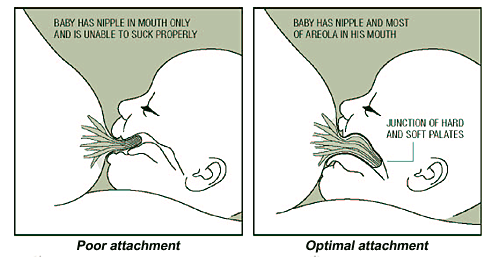
When feeding the infant's tongue grooves to support the nipple, fat pads stabilise and the nipple is drawn back to the point just before the hard and soft palate meet.
This is NOTHING like sucking a finger!!
IF a mum is experiencing sore/cracked nipples, her baby is not for whatever reason attaching and feeding effectively at the breast, we know this because when the baby has the nipple in the correct place - there is nothing to rub/cause friction or indeed damage the nipple. (see image above)
Engorged breasts are a separate issue to nipple trauma and occurs after milk has "come in" when mum has a supply too large or baby is not effectively draining the breast - which they wouldn't be if  sucking on it like a finger!
IF a baby is wanting to suck constantly, for loooong periods and all the time - establishing WHY is essential, nipples no more need conditioning for breastfeeding than a penis does for intercourse or a mouth does for talking - it's their biological function.
Please if you have a problem and are experiencing engorgement, soreness or cracked nipples - understand this is NOT just something that happens when you start breastfeeding. Seek help from someone fully qualified to help - ensure they have the letters IBCLC after their name!
I should of course also have mentioned breastfeeding counsellors and so on, but generally that raises discussion from someone who thinks they've seen a breastfeeding counsellor, but have actually seen a peer counsellor (as this discusses) and it seems to easily end up messy, so I went for short n direct .  What happened next is rather a shame as a mum who had experienced difficulties asked a question, I linked her to some free relevant information that could help her understand why she had struggled so much - and that plus following responses were immediately deleted.

Cover image expansion
Journal of Human Lactation
It genuinely baffles me when it comes to breastfeeding advice how so much evidence can just be dismissed in favour of opinion.  If you are sick you see a doctor, if you have a psychological illness you might see a psychologist and so on - within those professions you will have great and not so great practitioners, but the qualifications identify a basic level of training.  Furthermore few people would consider them qualified to start writing books on either of those subjects, particularly if they had no qualifications whatsoever and their ideas flew in the face of decades of science; even fewer I suspect would follow that advice if their own health was in question, particularly if their GP was pointing out all the flaws in the theory.

Yet infant feeding, which can be hugely important both for mothers who want to do it and from a health perspective, seems a free for all.  Despite the fact that unlike many other areas of parenting it's not "opinion based", milk production and transfer is of sound scientific base (the formula companies have spent bucket loads in exploring breastfeeding and breastmilk in their attempts to mimic it - what has been learnt in just the past twenty years is staggering).

The problem is that as a new mum, many can't tell good advice from bad; because those who don't fully understand breastfeeding see certain people still succeed even following the advice; that reassures them it must be good and if it doesn't work for them put it down to "some people just can't breastfeed".

In reality the amount of people who really can't breastfeed biologically is tiny, in practise the amount of people who really can't breastfeed is huge - because for whatever reason nobody managed to identify their problem and resolve it.  I have met mums who really couldn't breastfeed, but we have always worked as hard as possible to establish why (involving other health professionals and doctors as required).  If there is a true physical explanation for what is happening, whilst a mother may feel grief at the loss of a desired nursing relationship - she can begin to understand and be supported through the rest.

Leaving mums who wanted to breastfeed with no answers, opens the door to them feeling bad when the subject of infant feeding comes up - that perhaps they should have put up with agony or constant feeding or crying baby for longer, or defensive because they know what they endured and that it really wasn't working!  It hurts to read about risks of something they felt they had no other option but to do - and that sucks...Bigtime.  The system that failed to support them soon forget the mum they didn't help - but the mum has that experience for life.

Sadly this creates a catch 22 situation - some experts sell the notion it doesn't really matter (appealing to the biggest chunk of their market in most cases) because otherwise they would risk making mothers feel guilty and thus their market and ultimately profits would fall.  Instead they sell what they think mothers want to hear.  And so the cycle of passive and frankly often "never going to work" support continues....

Telling a mum with cracked/damaged nipples that her baby is attached perfectly is akin to suggesting trainers that causes huge blisters fit brilliantly.  The suggestion of finger sucking beyond bizarre.

Whether you follow Tizzie Hall as her biggest fan or not, if you have breastfeeding problems and want to succeed, please contact an expert.

RELATED BLOG POST: 

Why I'm concerned about Tizzie Hall's Breastfeeding Advice - PART 1

Contradictions in Tizzie Hall's response to FSID


So the feedback I'm receiving from mothers, includes a little confusion over a couple of points Tizzie made in regard to the FSID reply.  I suspect we will not receive further clarification from Tizzie, but I figured we could note the questions anyway :)  We welcome discussion via the comments section - unfortunately Tizzie has felt it necessary to censor responses on her web page so only those who do not question/disagree can reply; I am happy for everyone to have their say here as long as it remains polite and civil.  Name calling or aggressive posts will be removed.

Firstly, this is from one of my earlier posts, a point raised by Fleur and includes Tizzie's reply in red:
“On my calculation of the tog rating – Tizzie’s fans have repeatedly told me that the tog rating of her bamboo blankets is 0.64 tog x 16= 10.24 tog (apparently she has had them tested.) and a cotton sheet folded in 2, at approx 0.2 tog (x2= 0.4 tog). I also included in my calculations the toggage (made up word, lol) of the ‘safe sleeping bags’ that she sells, which will be either 1 tog or 2 tog, depending which one you choose, and the tog of the ‘double wrap’ which again, equates to 4 layers in itself (2 inside wrap pieces and 2 outside fold over bits) which again, could be anywhere from 1 tog to 4 tog, depending on the material used). I didn't include the tog of a vest, a sleepsuit or a nappy. That was how i worked out the approx 13+ togWhat Fleur has stated in her clarification is fine but adults also dress themselves similarly for bed, use a sheet and many adults sleep next to another person which provides extra warmth under their 11-13 tog duvets, yet we expect our babies to sleep in much less…….. 
So this appears to confirm that Fleur's calculation of 13+ tog was accurate?

You can see the sleeping bag and wrap that goes under the blankets here as Fleur describes.  The bedding guide states ALL infants should be swaddled until they show signs of trying to roll swaddled.

I must admit a thought I had upon watching this was how can the baby show hunger cues if they cannot get out of the swaddle? (as Tizzie claims in the clip) If babies love having their arms restricted, why would they try to get them free?  Why not swaddle with arms out so baby is comfortable and can easily demonstrate when hungry?  In the womb an infant's arms are never restricted in this way.

Tizzie goes on to say:
"My recommended range of blankets have been tested at 0.6 tog – that means we could place up to 9.8 layers of these recommended blankets over the baby. I am aware this is less than the 16 that I said was the maximum but in reality the majority of my clients don’t use that many layers. But I do not believe that a baby would come to any harm if the baby was 100% healthy, sleeping supine and with the head and face uncovered under 16 layers of my recommended blankets. You may choose to disagree… but can you show me research that can prove or deny this?
Yet on the FSID reply Tizzie states:
"I do not, for the majority, recommend covering with 10 tog or MORE of bedding. So therefore my recommendations I believe are consistent with FSID guidelines"
For the majority?  How does this make recommendations consistent.

Confused? 

Fleur was:
"The thing is, she (Tizzie) is not including the tog of the sleeping bag, the double wrap swaddle or the baby's clothing in her calculations! Yes, her layers of blankets at the maximum usage equates 9.6 togs at 0.6 tog each (although she actually had them tested at 0.64 tog each, meaning it's actually 10.24 tog), but then forgets about everything else.... A sleeping bag can be anywhere from 0.5 tog to 2.5 tog depending, (Tizzie recommends 1 tog in summer & 2 tog in winter) and then the double wrap is a special swaddle which has 4 layers over the baby, which again adds anywhere between 1 and 4 tog.... Plus a sleepsuit, vest and nappy, which would be approx another 2-3 tog, equals WAY above the 10 tog max that FSID said was a major risk!"
Some mums also questioned the statement that the majority of clients don't use that many layers.  Here is the quote from Tizzie's forum that opened the initial blog piece.
"We have noticed with the increased membership to our new forum area that there are quite a few of you who are using more than the total recommended amount of blanket layers. I know we are normally suggesting that baby’s are cold and you need to add layers, and in many cases this is correct but we do need to let you know that there is a limit to amount of layers that you should be using with your babies.
Tizzie recommends that the maximum blanket layers that should be used on a newborn to 3 month old baby sleeping in a bassinet is 10 layers, a newborn to 3mth old baby sleeping in cot is 12 layers and a baby 4 months and over is 16 layers.
Tizzie’s safe bedding guide is written on the amount of layers NOT how many tog those layers add up to."
Togs or layers?  But research generally examines tog - the recognised measurement of insulation (regardless of whether that is made of bamboo, fleece or wool!)

Too many blankets at least appears to be an ongoing issue according to other mothers.  This was taken from Tizzie's Facebook group back in March 2011 - the reply is from a frequently posting fan but despite Tizzie/her admin team moderating other posts, no warning/editing/deletion happened to this reply:
"Q ~ 'I've recently started my 7 month old on s.o.s routine. Day 4 and our nights are getting so much better. Before starting bub was waking every 2 hours sometimes less. My partner and I were exhausted. The first night he slept for 4 hours before needing to be resettled, second night was 7 hours and last night was 9.5 hours. Praying tonight is 12. Two little issues, first my boobs are killing me in the mornings now- I'm so engorged. And the second issue is that i think he is getting cold at night. I sleep him in a long sleeve onesie, a sleeping bag and a cellular blanket but he manages to wriggle out from under the blanket and when i go in to check on him he is sleeping on top of the blanket, and he is cold to touch.'

A ~ Do you have the bedding guide from the SOS website? It shows you what to dress bubs in for temps in various states. Best $9 you'll ever spend! Need to make sure everything is 100% cotton (incl. mattress protector) otherwise bubs will sweat. Most of us use many more blankets than the guide, every bubs is different eg. I'm in Sydney and in a room of 24.2C my 6m has 12 blankets on + the clothing, bag and wrap mentioned in the guide."

Fleur goes on to add:
"I asked about why use both before (sleeping bag AND wrap) and was told it was because it prevented babies from rolling onto their tummies much longer than 1 or the other. The FSID leaflet I have states to use one or the other, and that if the room is 18-20 then you shouldn't need any other bedding. It also has a temp guide and it's own bedding guide which says 1 cotton sheet, then as the temp gets colder, it suggests to add 1-4 layers of lightweight cotton blankets. 4 was the absolute max they advised." 
Sure enough here it is:
Tizzie then says:
"I would like to point out that if the above study was undertaken on baby’s 3 months and under, which I suspect it was then I do not recommend more than 12 layers for baby in cot and 10 layers for a baby in moses basket"
Yet the study I quoted in my previous reply showed overheating risks were elevated in older infants, not younger:
"Overheating and the prone position are independently associated with an increased risk of sudden unexpected infant deathparticularly in infants aged more than 70 days."
 BMJ 301 : 85 doi: 10.1136/bmj.301.6743.85 (Published 14 July 1990) Research ArticleInteraction between bedding and sleeping position in the sudden infant death syndrome: a population based case-control study

Could someone also clarify - are ALL Tizzie's blankets 0.6 tog? I keep reading about her "recommended 0.6 tog blanket", but she has five listed in her shop and none have the tog value labelled.

Several mums also commented on the statement:
"My confusion comes because research I have read by Monique P L’Hoir states “ we hypothesized that turning prone is prostponed when a sleeping bag was used, and even more so if the baby was tucked in with a blanket as well.”
Firstly, a hypothesis is a proposed explanation for a phenomenon - one then has to test whether the hypothesis is true for it to become evidence.  Secondly the article that contains the above can be found here but it doesn't discuss using both a swaddle and a sleeping bag and sheets and blankets; does anyone have a link to research supporting this?


Another issue not addressed is that of swaddling.  Tizzie herself directed mothers towards the International Society for the Study and Prevention of Perinatal and Infant Death (ISPID).  Their website states all mothers should be advised of the potential risks of swaddling; yet Tizzie's bedding guide that recommends all infants are swaddled and doesn't mention any risks.  They state:

"Numerous studies have documented a "tranquil" behavioural state and longer sleep periods in swaddled infants [10-14]. Thus, despite the unknown effects on the risk for SIDS, swaddling is becoming increasingly popular as a settling technique in the Netherlands, the United Kingdom and the United States [15, 16].
These findings logically suggest that infant swaddling would increase infant sleep time by preventing awakening. However this may not be a desirable outcome, as the pathogenesis of SIDS is thought to involve an impaired ability to arouse from sleep in response to a life threatening respiratory or cardiovascular challenge [17]. Arousal from sleep in infants is a hierarchical response proceeding from sub-cortical activation involving changes in heart rate and breathing, to full cortical arousal involving changes in brain activity; and this progression has been reported to be incomplete in infants who later died of SIDS [18]. Infant swaddling has been shown to minimise arousals from sleep, crying time, spontaneous startles and the progression to full arousal [1, 12, 14, 19]."
Tizzie seems to feel that FSID are led by sleeping bag companies:
"I can’t help but wonder here if it is FSID who are suggesting a sleeping bag or bedding or if it is the sleeping bag companies suggesting this…. "
and 
"They (FSID) might not have had time to do there own research and their recommendations might be based on what a sleep bag company has recommended to them. My advice is based on years of my study and observation of how babies sleep".
So perhaps FSID may clarify this?  I shall email them and ask!


UPDATE: A mum called Julie from Facebook has contacted a company called "Little Bamboo" to enquire as to the tog of their blankets. They sell a 120 x 150 cm bamboo blanket (100% bamboo with 100% cotton trim) at £14.95 here and have confirmed this is 0.6 tog (interestingly it looks very much like the blanket Tizzie lists for £46.30 here and Tizzie sells other items from the Little Bamboo range) This may be helpful to mums shopping for a cheaper alternative.

I also want to add details I have received via email - relevant excerpts below:
I've been wading through a number of research articles over this weekend (I'm an academic in a School of Public Health) 
The Fleming et al (1990) article you refer to regarding the increased risk at >10 tog clearly states that it is the COMBINED tog of BOTH clothing and bedding that needs to be taken into consideration, and as you've noted yourself, Tizzie does not include clothing or the sleep sack as part of her tog calculations. The article also indicates the relative risk increases from 8 tog, and is significantly higher at 10 tog or above.
I note that you have referred to the fact that older infants are more at risk of overheating than younger, and that Tizzie advocates putting MORE layers on older infants than younger. I thus found the following quote from Fleming et al (1990) particularly significant: 
"Unexpected findings were that among the infants who had died the older infants tended to be more heavily wrapped than the young ones, though no such trends were noted among the control infants, and that the increased risk of sudden unexpected death with overwrapping was significant for only the older infants. The higher ratio of mass to surface area in the older infants, together with their higher metabolic rates, may make them more vulnerable to the effects of increased thermal insulation".
Tizzie still does not provide any research evidence that turning prone is in response to temperature, and again in this regard is contradictory. She argues that babies are less able to regulate their temperatures effectively until they are 18 months old (again, her one size fits all approach), yet at the same time argues that babies are all apparently spinning over in a desperate attempt to get warm. Infants do in fact have the ability to thermoregulate and some research suggests they are more efficient at thermoregulation during sleep than adults. One of the risks of sleeping prone means that babies lose less heat from their bodies, so keeping them supine is obviously preferable. What is astounding is that advising placing excessive layers of blankets on a baby in fact reduces or perhaps removes the very reason why supine sleeping is protective, namely, the ability to dissipate excess heat.
I also want to copy a comment from the blog into the post:
"Not to add to your confusion: but Tizzie's understanding of tog is also fundamentally flawed, so her calculations are largely meaningless.
Tog is the level of thermal insulation offered by any one "covering device", if you will (I can't think of a better term!), and takes into account only that one garment. e.g. a 5 tog duvet is, indeed, 5 tog. However, tog can ONLY be measured in this way, by assessing the individual piece. The way that the material lies, the gaps inbetween individual layers, etc. all come into play when combining layers.
Essentially, what this means is that 2 x 2 tog does NOT necessarily equal 4 tog... and when so many layers are taken into account it's actually highly UNlikely that it would be a simple calculation. 15 x 1 tog blankets is very likely to have its own distinct tog rating of 20+ tog.
It's fundamentally simplistic and flawed thinking that makes someone like Tizzie Hall especially dangerous. Her words seem - to anyone not clever enough or simply not inclined to question - to "make sense" or be logical when they are in fact nothing of the sort. They're pseudoscience at best, outright guesses as a middle ground, and blatant lies at worst."

Tizzie Hall responds to FSID (PART 4)

Some mums have noted that comment moderation is in place on Tizzie Hall's own website - therefore I have reproduced an excerpt of her post with a link to the rest, you are welcome to comment here :)

Thank you Prof Haycock
I would like to thank Prof Haycock for taking the time to respond to the questions posed by Analytical Armadillo in concerns to my bedding advice. My official response is below. 
FSID believes that it is vital that all parents are offered safe sleep advice which is supported by independent, peer-reviewed scientific research. Babies are all very different so it is important for parents to be aware of their baby’s temperature by feeling their tummy or the back of their neck – not their hands or feet – and if they do feel hot they should remove a layer.
Here is our advice:
1. Babies do not need hot rooms and all night heating is rarely necessary.  Keep the room at a temperature between 16-20ÂşC.  18ÂşC (65ÂşF) is just right.  20 degrees is what I recommend in Australia and other areas on this side of the world and after a recent trip to the UK and Ireland I will now be recommending 18 degrees for that side of the world. My advice is consistent with FSID guidelines.
2. Adults find it difficult to judge the temperature in the room, so use a room thermometer in the rooms where your baby sleeps I always recommend my parents measure the room temperature with a room thermometer to establish the ambient temperature of the room. I recommend a room thermometer in my online store.
Taken from my bedding guide –
I suggest having a baby’s room cooled to 22 degrees centigrade in summer (if you are using air conditioning), or warmed to 20 degrees centigrade in winter. If you do not have hydronic heating, I suggest you use an oil-filled column heater. I do not advise using ducted heating in a baby’s room due to the dust it blows around. A good way of keeping an eye on the temperature is to use a room thermometer.” Please note:  to clarify one point above, I have found that if you set your air-conditioning to 22 degrees when trying to cool a room it gives a actual room temperature of 20 degrees.
My advice is consistent with FSID guidelines.
3. When you check your baby, if they are sweating or their tummy feels hot to the touch, take off some of the bedding or clothing. Don’t worry if their hands or feet feel cool, this is normal. I clearly state in my bedding this exact same thing. Here is the direct quote - 
Please note: Using the above guides, you will still need to watch your individual baby and adjust the bedding if your baby appears too hot or cold. Here are a couple of pointers to tell if your baby is too hot or cold. 
Signs of a baby who is too hot might include:
• the baby will be waking and moaning,
• having a sweaty back
• having sweaty or wet clothes.
• Shallow, rapid breathing
Signs that your baby is too cold might include:
• Moving all around the cot
• Never laying still
• Rolling on to their tummy
• Catnapping in the day, or
• Waking from 4am (but more often 5am)
You might also need to adjust the recommended bedding depending on the humidity level where you live as well.
The sheets and blankets in your child’s cot should be made from cotton or bamboo.
Tips:
• Never tuck a sleeping bag in under the mattress because this will restrict your little one’s movement and is dangerous.
• The most important rules to remember to protect your little one from SIDS are to have a totally smoke-free pregnancy and environment for your baby, and to always place a baby in the safe sleeping position on their back to sleep
• Toddlers over 18 months appear to be better at controlling their own body temperature while they sleep so might need less bedding.
• To see how I set a cot up with bedding please visit my BLOG February 2010
My recommendations are consistent with FSID guidelines.
 4. Use lightweight blankets or a baby sleeping bag. If your baby feels too warm, reduce the number of layers or use a lower tog baby sleeping bag. In warm summer weather, your baby may not need any bedclothes at all. Do not use a duvet, quilt or pillow for babies under 12 months. 
I am confused by the word “or” used here; “Use lightweight blankets or a baby sleeping sack” My confusion comes because research I have read by Monique P L’Hoir states “ we hypothesized that turning prone is prostponed when a sleeping bag was used, and even more so if the baby was tucked in with a blanket as well.” This statement is in line with what my observations have shown. Although I have also seen that if more lightweight bedding is used this may delay the baby rolling to their tummy for even longer. I can’t help but wonder here if it is FSID who are suggesting a sleeping bag or bedding or if it is the sleeping bag companies suggesting this….
For the research see information heading 134s COT DEATH AND SLEEPING SACKS the very last line states “we hypothesized that turning prone is prostponed when a sleeping back was used, and even more so if the baby was tucked in with a blanket as well.” http://www.ispid.org/fileadmin/user_upload/textfiles/SIDSI2006finalabstractbook.pdf
My recommendations is to use layers of lightweight 100% cotton or bamboo blankets and watch your baby for signs of being too hot or too cold as stated above. From my bedding guide
 “So why not just add more clothing under the sleeping bag and then eliminate the need for blankets? The reason I recommend using bamboo or cotton blankets along with a safe sleeping bag, and not normally using more than two layers of clothing underneath the sleeping bag, is because I feel more than two layers under a sleeping bag causes a risk of its own. You might for example, as advised by some sleeping bag manufacturers, add extra layers under your baby’s sleeping bag. Then, when you go in to check your little one at night and discover he feels too hot, you may decide not risk lifting him to remove some clothing layers because you are scared of waking him. You and I would like to think we would put safety first, but it’s important to remember that some nights we might feel too tired to risk waking our sleeping baby. In my opinion this is a far more dangerous situation than using bamboo or cotton blankets that can be added and removed as needed. On the other hand, if you found your baby was too cold without enough layers under his sleeping bag you might just grab the nearest thing – for example a quilt or polyester blanket – and throw it over your baby. A safer approach is to have the correct safe bedding at hand and educate the people who are around your baby at sleep times about how to put your little one to bed safely. My advice is consistent with FSID recommendations.
5. Even in winter, babies who are unwell and feverish need fewer clothes and bedclothes. Currently I do not have this warning in my bedding guide but as a result of this blog I have now realised that some parents are confused how to dress their babies and what to cover them with when unwell so I will be adding a paragraph to explain that less bedding and clothing is needed when a baby is unwell. My advice will be updated to include this FSID recommendation.
6. Babies need to lose excess heat from their heads. Make sure their head cannot be covered by the bedclothes by sleeping them ‘feet to foot’ (with their feet to the foot of the cot) so they don’t wriggle down under the covers.
Taken from my safe bedding guide –
  • The most important rules to remember to protect your little one from SIDS are to have a totally smoke-free pregnancy and environment for your baby, and to always place a baby in the safe sleeping position on their back to sleep
And taken from my SIDS article – http://www.saveoursleep.com.au/reading/free/sids.asp Which can be found under ‘Free Reading’ on my website –
Make sure your baby’s face and head stay uncovered while your baby is sleeping. A good way to ensure this is to put your baby’s feet at the bottom of the cot so that she can’t slip down underneath the bedclothes. Tuck in bedclothes securely so they can’t become loose. Never put quilts, doonas, duvets, pillows, lambskins or cot bumpers in a cot or under the sheet covering the mattress.
My grandmother says I should put a hat on my five-week-old baby to make him sleep better. What do you think? This is a question posed to me which is on my website and my answer to the question is below – this FAQ is also in my book.
I have heard this a few times and believe it to be a very dangerous old wives’ tale. You should most definitely not put a hat on your baby to help him sleep as this could cause your baby to overheat and will increase the risk of SIDS. If your baby is too hot and needs to cool down, he will need to be able to lose that heat through his head. You may put a hat on your baby if you are outdoors in cold weather, but take it off once inside.
My advice is consistent with FSID guidelines.
 7. Babies should never sleep with a hot water bottle or electric blanket, or next to a radiator, heater or fire, or in direct sunshine. I do not recommend any of these things but do not state this in my bedding guide. My advice will be updated to include this FSID recommendation.
8. When it’s warm, you can cool the room where your baby sleeps by closing the curtains and opening the windows during the day.  Offer your baby plenty to drink, and in very hot weather, sponge them down regularly with tepid water.  Use a fan but do not place it directly onto your baby. I concur as stated in my bedding guide.
My advice is consistent with FSID guidelines.
9. Remove hats and extra clothing as soon as you come indoors or enter a warm bus, train or shop, even if it means waking your baby. I have shown an example above where I also recommend this. My advice is consistent with FSID guidelines.
10. A car can become very hot in the summer. Avoid direct sunlight on your baby.  In winter, keep the heating low, and remove your baby’s outdoor clothing.  A thermometer may be helpful. I believe we have addressed this above. I will add the point about babies getting hot in cars to my SIDS article.  My advice is consistent with FSID guidelines
Research Evidence:
The most important publication implicating over-wrapping of babies as a risk factor for SIDS is the Confidential Enquiry into Stillbirths and Deaths in Infancy (CESDI) report 1 which had a very large dataset. Some of the data in the report had been published before. 2-4 In the chapter Thermal Environment and Arrangement of Bedding the authors state
 “For both the usual sleep and last/reference sleep, the SIDS infants were wrapped significantly more warmly than the control infants. The difference in the distribution of tog values remained significant when adjusted for socio-economic status. Notably twice as many SIDS infants put down for the last/reference sleep were covered by 10 tog or more bedding, and three times as many were found this way compared to the control infants.” – I do not, for the majority, recommend covering with 10 tog or MORE of bedding. So therefore my recommendations I believe are consistent with FSID guidelines. I recommend in my guide 6 layers of 0.6 tog blankets which is 3.6 tog plus a doubled over sheet of 0.4 tog totalling 4.0 tog and a maximum of 16 layers at 0.6 tog with is 9.6 tog include the doubled over sheet at 0.4 tog which is 10 tog. I note the above statement is 10 or more so I will adjust my maximum layers for a baby over 4 months sleeping in a cot to 15 layers as 16 layers equals 10 tog. I would like to point out that if the above study was undertaken on baby’s 3 months and under, which I suspect it was then I do not recommend more than 12 layers for baby in cot and 10 layers for a baby in moses basket – total 6.4 tog and 7.6 tog respectively (including doubled over sheet calculated to .4 tog) I also strongly advise my parents to begin with my recommended bedding, not my maximum bedding and watch their baby’s for signs of being too hot or too cold and add or remove the bedding as needed. My advice is 99% consistent with that of the current research outlined here  and I will adjust the maximum layers for a baby over 4 months sleeping in a cot to 15 layers of my recommended blankets.
To Note: You may argue that the ‘standard blanket layer’ is 1.5 to 2.0 tog however it is my belief that this average would have been achieved by evaluating the broad range of blankets on the market – cotton, bamboo, wool, polyester, polar fleece etc. I have not been able to find an answer to ‘what is the average tog of a cotton or bamboo blanket?’ so therefore I can only go with what the range of blankets I recommend have been tog tested too. I have made it clear in my bedding advice as taken from my bedding guide – “The sheets and blankets in your child’s cot should be made from cotton or bamboo
 CESDI indicated that worrying about overheating might actually be protective:
“Significantly more control than index mothers worried about their baby getting too hot, suggesting a protective effect…”
It was the mothers of the SIDS infants who worried most about their baby being too cold:
27.8% of the mothers of SIDS infants compared to 15.8% of controls. I would argue that parents following my routines and advice could be more aware of the dangers of both overheating and underheating than parents not following my advice because of the emphasis and importance I stress in bedding and setting up a safe sleeping environment. I would argue that you would find my parents would be monitoring their babies on a very regular basis.


CONTINUES HERE: http://blog.saveoursleep.com/2011/07/30/thank-you-prof-haycock/#respond


You can read Contradictions in Tizzie Hall's response to FSID HERE